Agency client reporting that clients actually read
The reports clients read fit on one page, with progress on their goal, what you shipped, numbers they can check and the decisions you need. Here is the structure.
On this page
Most client reports are written to prove effort, so they run long and get skimmed. The reports clients read fit on one page. They open with progress on the client’s goal, list what you shipped, show a few numbers the client can check, and end with the decisions you need from them. Everything else can live in an appendix or a dashboard.
Here is the structure, why each part earns its place, and how to keep reporting from eating every Friday.
Why clients skim reports
A business owner opens your report with one question: is this working? A 20-page export of every metric you track answers a different question, which is how busy you were. Owners notice the difference, and they stop reading.
The other problem is trust. When a report shows a number without saying where it came from, the client can’t check it and starts to wonder what was left out. A short report with sourced numbers reads as confident. A long one with unexplained charts reads as padding.
Start with the client’s goal, in their words
Before you design anything, write down the client’s goal the way they would say it: “fill our new Saturday hours,” “more calls from Google Maps,” “trial members who stay.” Then pick the one number that best tracks that goal, and agree on a target.
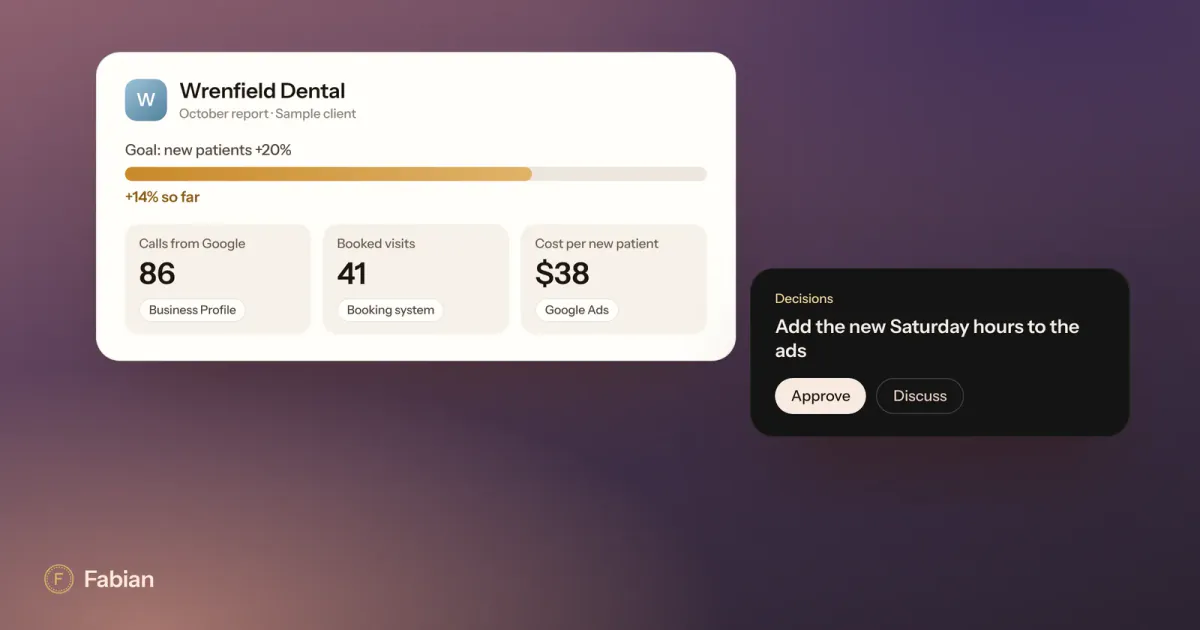
For Wrenfield Dental, a sample practice we use as an example, “fill our new Saturday hours” might become “new patients booked for Saturdays, target 20 a month.” Every report then opens with that number, how it moved and how far it is from the target.
If you can’t name the number, the engagement needs a conversation before it needs a report. Agreeing on it in writing also protects you later, when a client remembers the goal differently.
The one-page structure
Use the same six parts, in the same order, for every client:
- The headline. One sentence on progress against the goal. “Saturday bookings rose to 14 this month, against a target of 20.”
- What moved. Three to five numbers, each compared with the last period and with the target. Choose the numbers tied to the goal, not everything you can measure.
- What we shipped. A short list of finished work: pages published, campaigns launched, reviews answered, listings updated. Link each item so the client can see it.
- What we learned. One or two things that worked or didn’t, and what you will do about them. Include the misses. A report that admits one is easier to believe when it reports a win.
- Decisions we need. Each with your recommendation, the reason and a date. More on this below.
- Next period. The two or three things you will do next, each tied back to the goal.
Copy that outline into a document and hold it to one page. When a section runs long, the extra detail belongs in an appendix the client can open if they want it.
A filled-in example
For the sample Wrenfield Dental, an October page might read like this:
- Headline: Saturday bookings rose to 14, against a target of 20.
- What moved: Saturday new-patient bookings, 14 (9 in September). Calls from the Google listing, 46 (38). The search “dentist open saturday” moved from #11 to #4.
- What we shipped: Saturday hours on the Business Profile, a Saturday appointments page, replies to 12 new reviews.
- What we learned: The new page brings in calls. The Instagram promotion brought almost none, so it ends this month.
- Decision we need: Run search ads on Saturday mornings, at no extra monthly cost. We recommend yes. If we don’t hear by Thursday, the schedule stays as it is.
- Next month: Saturday ads, two posts about weekend visits, a goal check on November 30.
Link every number to its source
Every figure in the report should say where it came from and what it measures. A number the client can click and check does more for trust than a polished chart.
- Name the tool and the date range. “Calls from the Google listing, Oct 1 to 31” beats “Calls: 46.”
- Use each tool’s own definitions. Search Console counts an impression whenever a link to the site appears in results, clicked or not, and its average position is averaged across every query, as its help page on impressions, position and clicks explains. A Business Profile counts a call each time someone taps its call button, and counts views as unique visitors per day, according to Google’s guide to Business Profile performance. One line of definition means a client who checks gets the number you got.
- Report the actions that matter. In Google Analytics, those are the events you have marked as key events: a booking, a form, a call click. Report those instead of page views.
- State the caveats once. If cookie consent means analytics undercounts visits, or two ad platforms can claim the same sale, say so plainly next to the numbers it affects.
- Report results, not activity. “Ads brought back $2.40 for every $1” is a result. “We optimized the ad sets” is activity. If ad returns are part of the report, our guide to what a good ROAS is explains the break-even math worth showing a client.
Clients now ask about AI search too. If that is on a client’s mind, the impressions in Search Console’s generative AI report are a fair number to include, with the caveats in our guide to answer engine optimization for local businesses.
Put decisions on the page
The decisions section is the most useful part of the report and the one most often missing. Agencies tend to ask for approvals in scattered emails, then wait for answers that never come.
Write each decision the same way:
- The ask: “Move $400 a month from the TikTok test to the weekday push.”
- The reason: “The push brings back $2.40 for every $1. The test brings back $0.83.”
- Your recommendation and the default: “We recommend yes. If we don’t hear by Thursday, we’ll keep the current budget.”
A default keeps work moving without spending the client’s money behind their back. It also makes the report the place where things get decided, which gives the client a reason to open it every time.
Pick a cadence and keep it
Agree on the rhythm at the start, and don’t let it drift:
- Weekly: a short note with what shipped, any decision that can’t wait and anything unusual in the numbers. Five minutes to read.
- Monthly: the one-page report above.
- Quarterly: a review of the goal itself. Is it still the right goal? Is the target still right?
Send each one on the same day and at the same time, every period. A report that arrives every first Monday at 9 AM becomes part of the client’s routine, and a report that arrives whenever it is finished becomes one more email to get to later.
Make it work across clients
With five clients, a handmade report each month is manageable. With twenty, it can take a week. Three habits keep it in hand:
- One template, each client’s own goal. The six sections stay the same, so your team writes faster and clients learn where to look.
- Pull the numbers automatically, write the sentences yourself. The headline, the lessons and the decisions are what clients read closely, so that is where your team’s time should go.
- Keep a roll-up for yourself. One view of every client’s goal and open decisions shows you who needs attention before a client has to ask.
This is the work Fabian for agencies is built around. Each client gets a team with its own goals and memory, and every client’s decisions land in one list for you to approve, so the daily work happens without the Friday scramble.
Frequently asked questions
What should an agency client report include?
Lead with progress against the client’s goal, then three to five numbers compared with the last period and the target, a list of the work you shipped, what you learned, the decisions you need with a recommendation and a date, and the plan for the next period. Keep it to one page, and link each number to the tool it came from.
How often should agencies send client reports?
A short weekly note and a one-page monthly report work for most local business clients, with a quarterly review of the goal itself. The weekly note covers what shipped and anything urgent, and the monthly report covers results. Whatever rhythm you pick, send it on the same day and at the same time each period so clients know when to look.
How long should a client report be?
One page for the report itself. If a client wants more detail, put it in an appendix or a live dashboard they can open, and keep the page they read focused on results, finished work and decisions. A longer report rarely earns more trust. Numbers the client can check, and decisions laid out clearly, usually do.
How do you report a bad month to a client?
Say it in the headline, plainly, with the number. Then explain what you think caused it, what you have already changed and what you will watch next period. Clients take bad news better than surprises, and a report that names its misses makes the good months easier to believe. Never bury the drop on page three.
Should a client report include Google Analytics screenshots?
Only when a picture shows something a sentence can’t. Most clients take in a number with context faster than a chart: “Visits rose 12% to 9,164, against a 15% goal.” Link the number to the report it came from, so the client can open the source in Google Analytics whenever they want to check it.